
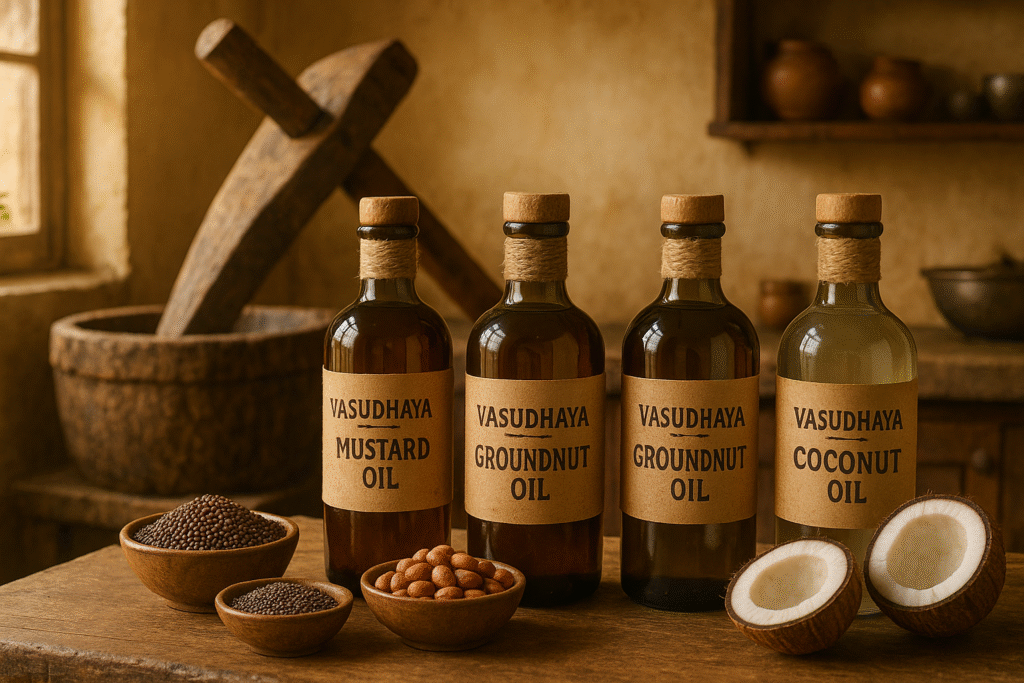
What does “wood‑pressed / kacchi ghani” mean?
Wood‑pressed (also called kacchi ghani or cold‑pressed) is a traditional extraction method where oil is pressed from seeds or coconuts using a wooden pestle in a slow‑moving mortar. The gentle process avoids high heat and harsh chemicals, helping preserve the oil’s natural aroma, color, and flavor.
Why it matters
- Gentle extraction: Lower friction and heat vs. industrial refining.
- Minimal processing: No solvent residues; no bleaching/deodorizing stages.
- Full‑bodied flavor: Real seed/coconut aroma that lifts everyday recipes.
Vasudhaya way: Small batches, careful seed selection, and honest, readable labels. If it’s not good enough for our kitchen, it’s not good enough for yours.
Meet the trio: Mustard, Groundnut & Coconut
1) Wood‑Pressed Mustard Oil
Taste & aroma: Peppery, pungent, and bold—perfect for North & East Indian cuisines.
Great for:
- Tadka & sautéing: Sarson ka saag, alu‑pyaaz, hearty dals.
- Pickling: Traditional achaar where bold flavor matters.
- Marination: Adds kick to fish, paneer, and mixed veggie grills.
Pro kitchen tip: Heat till it just shimmers for tadka (don’t smoke). For pickles, keep jars dry and use clean, dry spoons.
2) Wood‑Pressed Groundnut (Peanut) Oil
Taste & aroma: Mildly nutty, versatile, and family‑friendly.
Great for:
- Everyday sabzis: Bhindi, gobhi, mixed veg.
- Stir‑fries & chaat: Keeps flavors clean without overpowering.
- Light frying: Poha, upma, paneer tikkas on tawa.
Pro kitchen tip: A go‑to base oil for kitchens that want one oil to do (almost) everything.
3) Wood‑Pressed Coconut Oil
Taste & aroma: Tropical and soothing; a staple in South Indian cooking.
Great for:
- South Indian curries: Sambar, avial, thoran.
- Tempering & sautéing: Curry leaves, mustard seeds, dried red chillies.
- Baking & dessert: Adds gentle coconut notes to laddoos, cakes.
Pro kitchen tip: In cooler weather, coconut oil solidifies naturally—just place the bottle in warm water to liquify. This is normal and a sign of minimal processing.
Wood‑Pressed vs. Refined Oils (At a glance)
| Feature | Wood‑Pressed (Kacchi Ghani) | Refined |
|---|---|---|
| Extraction | Slow, low‑heat mechanical press | High‑heat + chemical steps |
| Aroma/Flavor | Natural, seed‑true | Neutral |
| Kitchen Use | Tadka, sauté, light frying, pickles | High‑volume frying, neutral taste |
| Transparency | Often small‑batch & local | Mass‑processed |
Note: For very high‑heat, repeated deep‑frying, some refined oils are chosen for stability and neutral taste. For everyday Indian cooking and flavor, wood‑pressed shines.
How to check for purity & quality
- Read the ingredient: It should list 100% single‑seed oil (e.g., only mustard / groundnut / coconut). No blends unless clearly stated.
- Look for batch details: Harvest/press date, lot/batch number, best‑before.
- Packaging: Food‑grade, preferably light‑protected bottles; leak‑proof caps.
- Aroma test: Real wood‑pressed oils carry a natural aroma. Too‑strong chemical notes? Skip.
- Label honesty: No unrealistic claims. Clear storage and usage guidance.
Storage & shelf‑life (simple rules)
- Keep cool & dark: Cupboard > next to stove.
- Seal tight: Close after every use to avoid oxidation.
- Use in time: For best aroma and taste, finish within suggested months on label after opening.
Quick everyday recipes (15–20 minutes)
A) Mustard Oil Tadka Dal
- Warm mustard oil till it shimmers.
- Temper cumin, mustard seeds, garlic, dry red chilli.
- Pour over cooked arhar/moong dal; finish with coriander and lemon.
B) Groundnut Oil Veg Stir‑Fry
- In groundnut oil, sauté ginger‑garlic.
- Add capsicum, beans, carrots; toss on high heat.
- Season with salt, pepper, splash of soy (optional), and roasted peanuts.
C) Coconut Oil Veg Thoran (Kerala‑style)
- Warm coconut oil; add mustard seeds, curry leaves.
- Toss in grated coconut, finely chopped beans/cabbage, green chilli, turmeric, salt.
- Cook briefly till crunchy‑tender.
Why choose Vasudhaya for your kitchen?
- Wood‑Pressed, Not Rushed: Traditional method, small batches.
- Seed‑to‑Bottle Care: Sourcing from trusted farmers.
- Label You Can Read: Straightforward ingredients and batch details.
- Made in India, For Indian Kitchens: Designed for tadkas, pickles, and everyday ghar‑ka‑khana.
Try our bestsellers:
- Vasudhaya Wood‑Pressed Groundnut Oil →
/products/wood-pressed-groundnut-oil - Vasudhaya Wood‑Pressed Mustard Oil →
/products/wood-pressed-mustard-oil - Vasudhaya Wood‑Pressed Coconut Oil →
/products/wood-pressed-coconut-oil
FAQ (For buyers who scan fast)
Q1. Can I deep‑fry with wood‑pressed oils?
Yes for occasional light frying at home. For repeated, ultra‑high‑heat deep‑frying, many kitchens prefer specific refined oils for stability and neutral taste.
Q2. Why does coconut oil solidify in winter?
That’s natural. Place the bottle in warm water and it will liquify. No need to microwave.
Q3. Is mustard oil too strong for daily use?
It’s bold, which many love—especially for North/East Indian dishes. Use less if you’re new to it, or blend with groundnut oil to soften the punch.
Q4. Are there additives or chemicals in wood‑pressed oils?
Authentic wood‑pressed oils are simply pressed from seeds/coconuts—no solvents. Always read labels.
The Vasudhaya Promise
Good food starts with honest ingredients. We press slowly, label clearly, and deliver fresh. If you ever receive a bottle you’re not happy with, contact us—we’ll make it right.